Every morning, in millions of Telugu households across the world — from Hyderabad and Vijayawada to Singapore, London, and New York — families begin their day the same way their ancestors did centuries ago: by consulting the Telugu Panchangam. Before scheduling a wedding, naming a newborn, breaking ground on a new home, or even setting out on a long journey, they turn to this ancient almanac to understand what the day holds. The Panchangam is not superstition. It is a sophisticated astronomical and spiritual system refined over thousands of years, a living tradition that reads the rhythms of the cosmos and translates them into guidance for daily human life.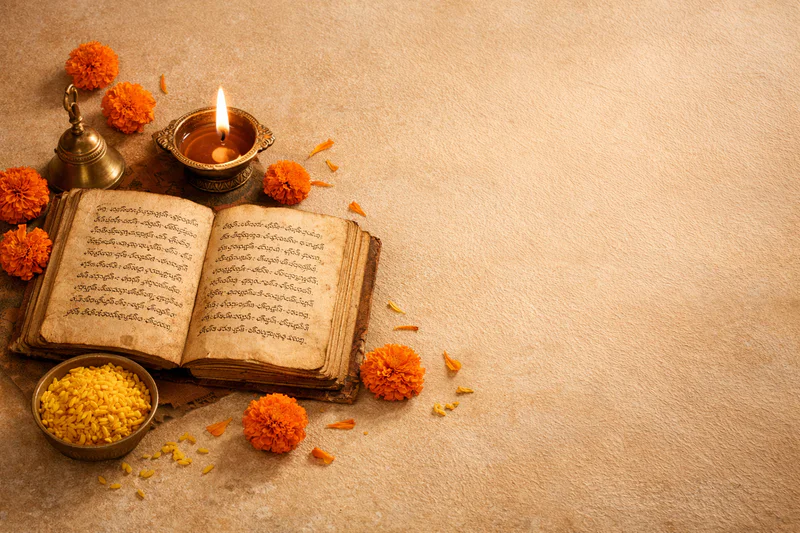
If you have ever wondered what Panchangam actually means, why your grandmother checks it before planning anything important, or how to read one yourself — this guide is for you.
What Does "Telugu Panchangam" Mean?
The word Panchangam (పంచాంగం) comes from two Sanskrit roots: pancha (పంచ), meaning "five," and anga (అంగ), meaning "limb" or "element." A Panchangam is therefore a "five-limbed" almanac — a calendar that tracks time through five distinct celestial measurements.
The Telugu Panchangam is the version of this almanac followed by Telugu-speaking communities of Andhra Pradesh, Telangana, and the Telugu diaspora worldwide. While the underlying astronomical science is shared across Hindu calendars, the Telugu system carries its own regional identity: it follows the Amanta lunar reckoning, is rooted in the Shalivahana Shaka era, and begins its new year at Ugadi (ఉగాది), the Telugu New Year celebrated at Chaitra Shukla Pratipada — the first bright lunar day after the new moon in the spring month of Chaitra.
Understanding even the basics of the Panchangam is a gateway into an entire worldview — one where time is not simply a ticking clock, but a living, breathing field of cosmic energies that shape what we do and when we do it.
The Five Limbs of the Telugu Panchangam
The heart of the Panchangam is its five components. Each is derived from real astronomical observations of the Sun and Moon. Together, they create a precise portrait of any given moment in time.
1. Tithi (తిథి) — The Lunar Day
A Tithi is the lunar day, defined by the angular distance between the Sun and the Moon. Each Tithi spans exactly 12 degrees of separation between the two luminaries, which means a lunar month of 360 degrees contains exactly 30 Tithis.
There are 15 Tithis in each fortnight (Paksha). The bright fortnight, Shukla Paksha (శుక్ల పక్షం), runs from the new moon to the full moon. The dark fortnight, Krishna Paksha (కృష్ణ పక్షం), runs from the full moon back to the new moon. The 15th Tithi of Shukla Paksha is Purnima (పౌర్ణమి) — the full moon — and the 15th Tithi of Krishna Paksha is Amavasya (అమావాస్య) — the new moon.
Because a Tithi is measured by celestial angles rather than clock hours, it can be slightly shorter or longer than 24 hours. This means a Tithi may begin on one day and end partway through the next — a subtlety that the Panchangam accounts for carefully.
Each Tithi carries its own energy and suitability for activities. Tithis 1, 6, and 11 (called Nanda) are good for starting new ventures. Tithis 4, 9, and 14 (Rikta) are considered less favorable for auspicious beginnings. Knowing the Tithi helps families choose the right moment for everything from haircuts to house-warmings.
2. Nakshatra (నక్షత్రం) — The Lunar Mansion
The sky is divided into 27 Nakshatras (sometimes 28, with the special Abhijit included), each spanning 13 degrees and 20 minutes of the zodiac. As the Moon travels through its monthly orbit, it passes through each Nakshatra in sequence. The Nakshatra of the day is determined by which of these lunar mansions the Moon is currently occupying.
Each Nakshatra has a ruling planet, an associated deity, and a distinct character. Some well-known Nakshatras and their qualities:
Rohini (రోహిణి) — governed by the Moon, associated with fertility, beauty, and material abundance; one of the most auspicious Nakshatras for marriages
Pushyami (పుష్యమి) — governed by Saturn, considered the most nurturing of all Nakshatras, ideal for beginning education or spiritual practices
Uttara Phalguni (ఉత్తర ఫల్గుణి) — associated with commitment and partnership, highly favored for weddings
Sravana (శ్రావణం) — governed by the Moon, associated with listening, learning, and divine connection
Beyond just auspiciousness, a child's birth Nakshatra — determined by the Moon's position at the moment of birth — forms the foundation of their Vedic birth chart and is central to naming ceremonies, compatibility matching for marriage, and lifelong spiritual practice.
3. Yoga (యోగం) — The Luni-Solar Combination
Yoga in the context of Panchangam does not refer to physical postures. It is a time period calculated by adding the longitudes of the Sun and the Moon and dividing the total by 13 degrees 20 minutes. This produces 27 Yogas in total, which cycle continuously throughout the year.
Of the 27 Yogas, roughly 9 are considered auspicious and 9 inauspicious, with the remaining being neutral. The three most beloved auspicious Yogas are:
Siddhi Yoga — the yoga of fulfillment; activities begun now tend to succeed
Amritha Yoga — the yoga of nectar; associated with prosperity and healing
Shubha Yoga — simply "auspicious"; considered favorable for all beginnings
Among the inauspicious Yogas to avoid for important work are Vishkambha, Vyatipata, Vaidhriti, Shoola, and Atiganda. Families planning weddings or business launches are particularly careful to avoid these.
The beauty of Yoga is that it synthesizes both solar and lunar energies into a single reading — a snapshot of the combined cosmic mood of the day.
4. Karana (కరణం) — The Half-Lunar Day
A Karana is half of a Tithi. Since each Tithi spans 12 degrees of the Sun-Moon arc, a Karana spans 6 degrees. Each day therefore contains two Karanas — one in the first half and one in the second half of the lunar day.
There are 11 types of Karanas in total: 7 movable (Chara) Karanas that repeat through the month, and 4 fixed (Sthira) Karanas that occur only once per lunar month. The 7 movable Karanas are Bava, Balava, Kaulava, Taitila, Garija, Vanija, and Vishti.
Of these, Vishti Karana (also called Bhadra) is the most important to note. It is considered highly inauspicious for beginning any new or auspicious activity. Priests and astrologers are particular about ensuring that wedding ceremonies and important rituals do not begin during Vishti. Conversely, Bava and Balava Karanas are among the most favorable for ceremonies.
Because Karanas change roughly every 6 hours, they offer a finer-grained layer of timing guidance than any of the other Panchangam elements — useful when you need to choose not just the right day, but the right part of the day.
5. Vaaram (వారం) — The Day of the Week
Vaaram is the weekday, and each day is governed by a planet (Graha) that influences the character and energy of that day:
Aadivaaram (ఆదివారం) — Sunday — governed by Surya (Sun)
Somavaaram (సోమవారం) — Monday — governed by Chandra (Moon)
Mangalavaaram (మంగళవారం) — Tuesday — governed by Mangala (Mars)
Budhavaaram (బుధవారం) — Wednesday — governed by Budha (Mercury)
Guruvaaramu (గురువారం) — Thursday — governed by Guru (Jupiter)
Shukravaaram (శుక్రవారం) — Friday — governed by Shukra (Venus)
Shanivaaram (శనివారం) — Saturday — governed by Shani (Saturn)
Thursday and Friday are generally considered the most auspicious days for beginning ventures and ceremonies. Monday is beloved for travel and devotional activities connected to Lord Shiva. Vaaram is the only element of the Panchangam that aligns with the Western calendar — the seven-day week is universal, though the spiritual significance of each day differs.
The Telugu Calendar System: Amanta, Shaka Samvat, and the 60-Year Cycle
The Telugu Panchangam is not simply a translated version of a generic Hindu calendar. It rests on a distinct regional tradition with deep historical roots.
The Amanta System
Telugu-speaking communities follow the Amanta (అమాంత) system of lunar reckoning — also called Amavasyanta — in which each lunar month ends on Amavasya (the new moon) and begins fresh the following day. The month opens with Shukla Paksha (the bright fortnight) and closes with Krishna Paksha (the dark fortnight).
This differs from the Purnimanta system used in North India, where the month ends on Purnima (the full moon). The practical effect is that Krishna Paksha days carry different month names in the two systems — the same calendar day will be called "Magha Krishna Paksha" in the Telugu Amanta tradition and "Phalguna Krishna Paksha" in the North Indian Purnimanta tradition. Both systems observe the same Tithi on the same day; they simply assign it to different months.
The Amanta system is characteristic of the peninsular states: Andhra Pradesh, Telangana, Karnataka, Maharashtra, and Goa all follow it.
Shalivahana Shaka (శాలివాహన శక)
The Telugu calendar measures years by the Shalivahana Shaka era, established in 78 CE. The era commemorates King Gautamiputra Satakarni of the Satavahana dynasty, known as Shalivahana, who ruled the Deccan region. This calendar system — also called Saka Samvat — is 78 years behind the Gregorian calendar. The year 2026 CE corresponds to Shaka Samvat 1948.
This is the same system that forms the basis of India's official National Calendar today, a reflection of just how central the Telugu-Deccan tradition has been to the subcontinent's timekeeping heritage.
Ugadi and the 60-Year Samvatsara Cycle
The Telugu New Year, Ugadi (ఉగాది), falls on Chaitra Shukla Pratipada — the first day of the bright fortnight in the month of Chaitra, typically in March or April. On Ugadi, families gather to read the Panchanga Sravanam — a ritualistic recitation of the year's Panchangam — performed by the family priest or an elder, laying out the cosmic blueprint for the entire year ahead.
Each Telugu year has a name from a cycle of 60 Samvatsaras (సంవత్సరాలు). The cycle repeats every 60 years, derived from the combined orbital rhythms of Jupiter (which takes 12 years to orbit the Sun) and Saturn (which takes approximately 30 years). The least common multiple of these two cycles yields 60 — the foundation of this ancient astronomical calendar. The year 2025–2026 is Vishwavasu (విశ్వవసు); the following year 2026–2027 will be Parabhava (పరాభవ).
These year names are not arbitrary. Each carries a characterological forecast — an ancient tradition of giving the year itself a personality, much as cultures give names to hurricanes or ships.
Why the Panchangam Still Matters: Auspicious Times in Daily Life
One of the most practical uses of the Panchangam is the identification of Muhurtham (ముహూర్తం) — auspicious time windows — and Ashubha Kaalas — inauspicious periods to avoid. This is where the Panchangam moves from astronomy into lived experience.
Inauspicious Periods
Rahukalam (రాహుకాలం): A 90-minute window each day ruled by Rahu, the shadow planet. Rahu Kalam varies by day of the week and is calculated by dividing the time between sunrise and sunset into eight equal segments. It is strictly avoided for starting any new auspicious work — travel, business launches, weddings, or rituals.
Yamagandam (యమగండం): The period of Yama, lord of death. Only death-related rituals are considered appropriate during this window; all other new activities are avoided.
Durmuhurtham (దుర్ముహూర్తం): Literally "bad Muhurtham" — specific windows during the day that carry inauspicious energies, calculated from the day's sunrise and sunset.
Varjyam (వర్జ్యం): A period associated with Gulika, the son of Saturn. It is generally avoided for all important undertakings.
Auspicious Periods
Abhijit Muhurtham (అభిజిత్ ముహూర్తం): The most universally powerful auspicious window — approximately 48 minutes centered around solar noon (midday). It is the 8th of the 15 equal divisions of the daytime and is said to carry the blessings of both Lord Vishnu and Lord Shiva. It can overcome the doshas (flaws) of many inauspicious combinations, making it a reliable fallback for important activities on any day.
Amrit Kalam (అమృత కాలం): The "nectar period" — a 90-minute window considered highly favorable, tied to the specific Nakshatra of the day. Activities begun during Amrit Kalam are believed to yield enduring positive results.
All of these timings are location-dependent: they shift with the local sunrise and sunset, which is why a Telugu family in Singapore observes different Rahukalam hours than one in Hyderabad or New York.
Planning Life's Important Moments
The Panchangam is consulted for virtually every significant occasion:
Weddings (వివాహం): The family priest examines all five Panchangam elements alongside the horoscopes of bride and groom to find a Muhurtham that maximizes harmony and longevity.
Gruha Pravesham (గృహ ప్రవేశం): The housewarming ceremony is timed to a day when the five limbs align favorably, ensuring prosperity for the new home.
Namakaranam (నామకరణం): The baby naming ceremony, typically on the 11th day after birth, is conducted at an auspicious time drawn from the Panchangam.
Vidyarambham (విద్యారంభం): The initiation of a child's formal education is timed to an auspicious Nakshatra and Vaaram, traditionally Saraswati Puja or Vijaya Dasami.
Business inaugurations and travel: Even for everyday decisions, many Telugu families check the daily Panchangam before setting out on long journeys or signing important agreements.
This is not a relic of a pre-modern world. It is a living practice — a way of bringing intentionality and spiritual awareness to how time is used.
How the Telugu Panchangam Differs from Other Regional Calendars
While all Hindu Panchangams share the same five-limb structure, the Telugu Panchangam has features that make it distinctively its own:
Amanta vs. Purnimanta: As described above, the Amanta system gives Krishna Paksha days their month name from the current month, not the following one — placing the Telugu calendar in alignment with Karnataka, Maharashtra, and Goa, and distinct from the North Indian tradition.
Telugu month names: The Telugu calendar uses the classical Sanskrit-derived names (Chaitra, Vaisakha, Jyeshtha, Ashadha, Sravana, Bhadrapada, Asvayuja, Kartika, Margasira, Pushya, Magha, Phalguna), but the Telugu renderings of these names carry their own regional pronunciation and cultural associations. Sravana, for instance, is deeply associated with the monsoon season and the festival of Varalakshmi Vratam in Telugu households.
60-year Samvatsara naming: The cycle of 60 named years is used across South India but is especially central to Telugu cultural identity — each new year's name is announced with ceremony at Ugadi and shapes the character of that entire year's predictions.
Ugadi as New Year: Unlike the Vikram Samvat tradition of North India (which observes Gudi Padwa on the same day but marks it differently), the Telugu Ugadi celebration includes the preparation and sharing of Ugadi Pachadi — a dish containing all six tastes — symbolizing the full spectrum of life's experiences in the year ahead.
Frequently Asked Questions
What is a Telugu Panchangam and who uses it?
A Telugu Panchangam is a Hindu almanac — a daily calendar that tracks five celestial elements (Tithi, Nakshatra, Yoga, Karana, and Vaaram) — used by Telugu-speaking Hindu communities. It is consulted to identify auspicious and inauspicious times for religious ceremonies, life events, daily prayers, and planning. It follows the Shalivahana Shaka calendar era and the Amanta lunar system.
What is the difference between Tithi and a regular calendar date?
A regular calendar date (like March 12) is based on the solar year and is fixed. A Tithi is a lunar day defined by the angular distance between the Sun and Moon. Because the Moon does not move in perfect sync with the Sun, a Tithi can span anywhere from about 19 to 26 solar hours. This means a Tithi can sometimes begin and end within the same calendar day, or straddle two calendar days. The Panchangam lists which Tithi governs each calendar day, and at what time it changes.
What is Rahukalam and why should it be avoided?
Rahukalam is a 90-minute period each day that falls under the influence of Rahu, a shadow planet considered inauspicious in Vedic astrology. It is calculated by dividing the time between sunrise and sunset into eight equal parts; the Rahu period falls on a different segment each day of the week. It is traditionally avoided for starting new activities — travel, business, ceremonies, or important decisions — because beginning something during Rahukalam is believed to invite obstacles and unfavorable outcomes. Normal daily activities throughout the rest of the day are unaffected.
How is the Telugu Panchangam year different from the Gregorian year?
The Telugu Panchangam year is a lunisolar year that begins at Ugadi (Chaitra Shukla Pratipada), typically in March or April of the Gregorian calendar. It is counted in Shalivahana Shaka years, which are 78 years behind the Gregorian count. The Telugu year has 12 lunar months of approximately 29.5 days each, with a leap month (Adhika Maasa) inserted roughly every 2.5 to 3 years to keep the lunar calendar aligned with the solar seasons. Each year also carries a unique name from the 60-year Samvatsara cycle.
Can I use a Telugu Panchangam if I live outside India?
Absolutely — and this is one of the most important aspects of a proper Panchangam. While the five elements (Tithi, Nakshatra, Yoga, Karana, Vaaram) are the same everywhere in the world on a given day, the timing-based elements — Rahukalam, Yamagandam, Durmuhurtham, Abhijit Muhurtham, Varjyam, Amrit Kalam, sunrise, and sunset — all depend on your local geography. A Telugu family in Singapore has sunrise and sunset times quite different from Hyderabad, which means their Rahukalam falls at completely different clock hours. A reliable Panchangam app or service will compute these timings specifically for your city, ensuring the guidance is accurate for where you actually live.
Keeping the Tradition Alive Wherever You Are
There is something quietly profound about a family in London or Sydney checking the same Panchangam their great-grandparents consulted in a village in coastal Andhra. The stars and the Moon are the same sky, the five limbs are the same ancient framework, and the intention — to live with awareness, to choose auspicious moments, to honor the cosmos in daily life — is unchanged across generations and continents.
The challenge for Telugu families living abroad is access. A Panchangam printed in Hyderabad is calculated for Indian Standard Time and doesn't account for your sunrise in New York or Singapore. Gathering information from multiple sources, reconciling Telangana and Andhra traditions, and finding bilingual (Telugu and English) explanations can turn a meaningful daily practice into a frustrating search.
That is exactly the gap the Telugu Calendar app was built to fill. Available for both iOS and Android, it delivers a fully computed daily Telugu Panchangam — Tithi, Nakshatra, Yoga, Karana, and Vaaram — along with all location-aware timings: Rahukalam, Yamagandam, Durmuhurtham, Abhijit Muhurtham, Varjyam, and Amrit Kalam, calculated precisely for your city. Whether you're in Hyderabad, Vijayawada, Singapore, New York, London, or Sydney, the timings are specific to your local sunrise and sunset. The app also includes 60+ Telugu and Hindu festival dates, a daily Bhagavad Gita verse, and is fully bilingual in Telugu and English — so the next generation can engage with the tradition in the language they're most comfortable in.
If you want to bring the daily rhythm of the Panchangam into your home — wherever in the world that home may be — the Telugu Calendar app is a simple, dignified place to start.