Ugadi 2026 arrives on Thursday, March 19, 2026 — and with it comes the familiar rush of anticipation that Telugu families across the world know so well. The fragrance of neem flowers, the bright gleam of new silk, the torana of mango leaves swaying at the doorway, and the complex, irreducible taste of Pachadi on the tongue. This is how a new year should begin: with all its sweetness and bitterness served at once, with honesty and grace.
For millions of Telugu-speaking Hindus in Andhra Pradesh, Telangana, and across every continent where the community has put down roots, Ugadi is not merely a date on a calendar. It is the beginning of time renewed — a cosmic reset marked by ritual, family, and five thousand years of living tradition.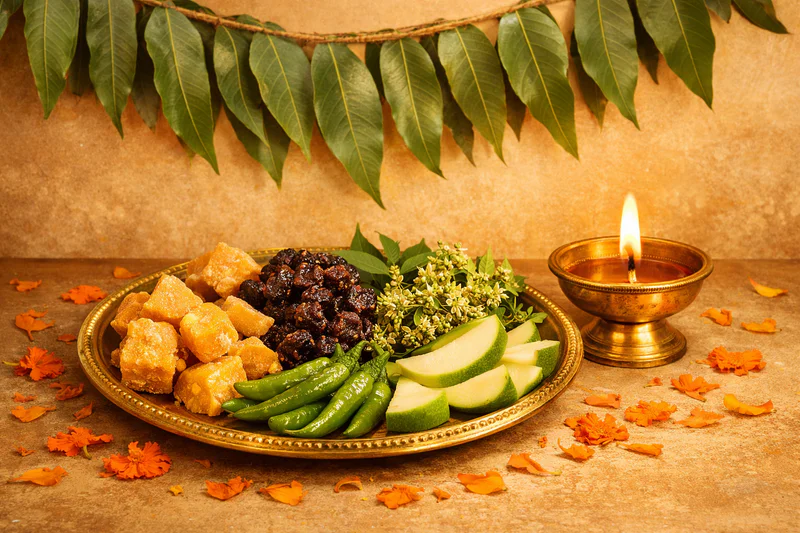
When Is Ugadi 2026?
Ugadi 2026 falls on Thursday, March 19, 2026.
The festival is observed on Chaitra Shukla Pratipada — the first day of the bright fortnight of the Hindu lunar month of Chaitra. The astronomical timings for 2026 are as follows:
Pratipada Tithi begins: approximately 06:52 AM on March 19, 2026
Pratipada Tithi ends: approximately 04:52 AM on March 20, 2026
The entire day of March 19 falls within the Pratipada Tithi, making it the ideal day for celebration, ritual, and the auspicious beginning of Sri Parabhava Nama Samvatsaram.
The Outgoing Year
The year 2025–2026 was known as Vishwavasu Nama Samvatsaram — the year of the "Universal Giver." As it draws to a close on March 18, it hands the reins to a new named year, a new cycle of possibilities.
What Does "Ugadi" Mean?
The word Ugadi is a beautiful compression of two Sanskrit words: Yuga (era or age) and Aadi (beginning). Together, they mean the beginning of a new era — a name that carries enormous spiritual weight.
This is not simply a cultural new year in the way that January 1 is a new year. Ugadi marks the day Hindu cosmology holds that Lord Brahma, the creator, set the universe into motion — the moment that time itself began. Every year, when the moon stands at the beginning of Chaitra and the earth tips gently toward spring, that primordial act of creation is remembered and renewed.
The festival is also astronomically grounded. It falls after the new moon (Amavasya) that ends the month of Phalguna, when the sun has crossed the celestial equator moving northward. This is the Uttarayana — the auspicious half of the year, bright and ascending. Ugadi thus aligns the human calendar with the rhythms of the cosmos: a new lunar year beginning at the threshold of spring, when the Deccan plateau blooms with flowers and the promise of harvest.
Sri Parabhava Nama Samvatsaram: The New Year Name
Each year in the Hindu calendar carries a unique name, cycling through a set of 60 Samvatsarams — a complete cycle that repeats over sixty years. This naming tradition is one of the most poetic features of the Shalivahana calendar, giving each year its own character and significance.
The new year beginning on March 19, 2026 is Sri Parabhava Nama Samvatsaram — the fortieth in the sixty-year cycle.
The word Parabhava carries layered meaning. At its core, it signifies the dissolution of ego, the humbling of arrogance, and transformation through self-awareness. Classical Vedic texts offer the verse: "Parābhavas tāvad abodha-jāto yāvan na jijñāsata ātma-tattvam" — one remains in a state of defeat only so long as one fails to seek the true nature of the self. The year is thus not a warning but an invitation: to look inward, to act with wisdom over pride, and to let genuine understanding guide one's choices.
Astrologers reading the Panchangam for this year note that Jupiter serves as the governing force, bringing the themes of knowledge, spiritual inquiry, and generosity to the fore. It is considered a year that rewards humility and thoughtful action — fitting counsel for any new beginning.
Ugadi Panchangam Sravanam: Listening to the Year Ahead
One of the most distinctive and beloved Ugadi traditions is the Panchanga Sravanam — literally, the listening to the Panchangam. On Ugadi morning, across temple halls and family courtyards from Hyderabad to Houston, scholars and priests open the new year's almanac and read aloud its predictions for the year ahead.
The Panchangam is not merely a calendar. It is a sophisticated document that maps five elements of time — Tithi (lunar day), Vara (weekday), Nakshatra (star), Yoga, and Karana — along with planetary positions, eclipse dates, auspicious periods, and detailed forecasts for rainfall, agriculture, health, and prosperity.
The Sravanam ritual transforms this information into a communal act. Families and communities gather, seated facing north as tradition recommends, to receive the year's wisdom together. The presiding priest invokes the spirit of Lord Brahma, the original keeper of cosmic time, before presenting the almanac's contents. Predictions are made about the rains, harvests, economic outlook, and the influence of planets on the twelve zodiac signs.
For many families, this moment is as emotionally resonant as the feast itself. It is an act of collective preparedness — a community gathering at the threshold of a new year, looking forward together with faith and awareness, armed with the tools of an ancient astronomical tradition.
Ugadi Traditions and Rituals
Abhyanga Snanam: The Oil Bath at Dawn
Ugadi begins before sunrise. The household stirs early, and the first ritual is the Abhyanga Snanam — a ceremonial oil bath in which sesame oil is applied to the body before bathing. This is considered a deeply purifying act, cleansing not only the body but the spirit, preparing the person for prayer and celebration. The fragrance of sesame oil in the early morning air is, for many, the unmistakable scent of Ugadi itself.
Neem Eating: Embracing Bitterness
After the oil bath and prayers, families gather to consume a small amount of fresh neem flowers — often mixed with a little jaggery. Neem is one of the bitterest tastes known in Indian cuisine, and eating it on Ugadi is entirely intentional. It is a ritual acknowledgment that the year ahead will not be without hardship, and that hardship, faced with courage, has its own value. Neem also carries significant Ayurvedic properties, with traditional medicine celebrating it as a purifier of the blood and a strengthener of the immune system at the start of the new season.
New Clothes and Gifts
Wearing new clothes on Ugadi is a universal tradition — a physical expression of renewal. Families dress in their finest, often in bright silks and traditional attire. Elders bless the younger members of the family, gifts are exchanged, and the atmosphere carries a particular warmth that belongs only to this day.
Mango Leaf Torana
Before sunrise, doorways are adorned with fresh green mango leaf strings — called torana in Telugu. The tradition carries both aesthetic and spiritual meaning. Mango leaves are considered deeply auspicious in Hindu tradition, associated with Lord Ganesha and his brother Subramanya, both said to have a particular love for mangoes. The fresh green of new mango leaves also marks the season: spring has arrived, the trees are blooming, and the earth is renewing itself. The torana at the doorway signals to all who pass that this household is ready to welcome the year.
Rangoli and Temple Visits
Homes are decorated with Muggulu (rangoli patterns) drawn at the entrance, and families visit their local temples for special Ugadi pujas. The temples are crowded, fragrant with flowers and incense, and filled with the sound of prayers and bells. It is one of those mornings when the sacred and the everyday feel very close to each other.
Ugadi Pachadi: The Six Tastes of Life
No aspect of Ugadi is more philosophically rich — or more delicious — than Ugadi Pachadi. This is a chutney-like dish prepared fresh on the morning of the festival, combining six distinct ingredients that together represent the full spectrum of human experience.
The six ingredients and their symbolism are:
Together, these six tastes are called Shadruchulu in Telugu. The wisdom embedded in Ugadi Pachadi is quietly revolutionary: by eating all six tastes together at the start of the year, you are not wishing for only sweetness. You are acknowledging — and accepting — that the year will bring all of it. The joy and the grief. The excitement and the disappointment. The familiar sweetness and the sharp, unexpected tang.
This is not resignation. It is a profound form of readiness. Ugadi Pachadi is the taste of life itself, served in a single bowl.
Ugadi Across Regions: One Festival, Many Expressions
Ugadi is the shared new year of a broad swathe of peninsular India, and while the spirit is universal, each region brings its own flavor to the celebration.
Andhra Pradesh and Telangana
In the Telugu heartland, Ugadi is celebrated with particular grandeur. Families prepare elaborate feasts that include pulihora (tamarind rice), bobbatlu (sweet lentil flatbreads), mango dal, and the traditional Pachadi. Panchanga Sravanam is a central ritual, held at temples and community gatherings. Cities like Hyderabad, Vijayawada, Tirupati, and Visakhapatnam come alive with the sounds of celebration.
Karnataka: Yugadi
In Karnataka, the same festival is called Yugadi — a name that stays closer to the original Sanskrit. The spirit is identical, though Karnataka adds its own culinary signature with Holige (also called Obbattu), a sweet flatbread stuffed with lentil and jaggery, and a specific preparation called Bevu Bella — a simple mixture of neem and jaggery that distills the Pachadi's philosophy into two ingredients: the bitter and the sweet. Carnatic music performances and classical dance recitals are traditional features of Yugadi celebrations in Karnataka.
Maharashtra: Gudi Padwa
Maharashtra celebrates the same Chaitra Shukla Pratipada as Gudi Padwa. The most visible expression of this festival is the Gudi — a bamboo staff dressed in bright silk, topped with an inverted copper pot, and raised outside the home's main entrance. The Gudi symbolizes victory, prosperity, and divine protection, and its hoisting is accompanied by prayers to Lord Vishnu. Gudi Padwa shares its date with Ugadi exactly: both fall on March 19, 2026, and both mark the beginning of Sri Parabhava Nama Samvatsaram.
Ugadi in the Diaspora
For Telugu communities in Singapore, the United States, the United Kingdom, Australia, and beyond, Ugadi has become an anchor of cultural identity. Cultural associations organize community Panchanga Sravanam events, traditional food festivals, and Ugadi celebrations that bring families together across vast distances. The festival reminds the diaspora of who they are and where they come from — no matter how far from home they happen to be.
Vasanta Navratri Begins on Ugadi
Ugadi also marks the beginning of Vasanta Navratri — also known as Chaitra Navratri. This nine-day festival honoring the goddess Durga in her various forms begins on Chaitra Shukla Pratipada and concludes on Ram Navami, the ninth day, which celebrates the birth of Lord Rama. For many devout families, the Navratri that begins on Ugadi is a period of fasting, prayer, and spiritual renewal that deepens the significance of the new year's opening days.
Frequently Asked Questions
What is the date of Ugadi 2026?
Ugadi 2026 falls on Thursday, March 19, 2026. The Pratipada Tithi begins at approximately 06:52 AM on March 19 and ends at approximately 04:52 AM on March 20, making March 19 the day of celebration.
What is Sri Parabhava Nama Samvatsaram?
Sri Parabhava Nama Samvatsaram is the name of the Hindu new year beginning on Ugadi 2026. It is the fortieth year in the sixty-year Samvatsara cycle of the Shalivahana calendar. Parabhava carries the meaning of ego's dissolution and transformation through self-knowledge — a year that is said to favor wisdom, humility, and action rooted in dharma over personal ambition.
What are the six tastes of Ugadi Pachadi and what do they mean?
Ugadi Pachadi combines six ingredients representing the full range of life's experiences: jaggery (sweet — joy), tamarind (sour — challenges), neem flowers (bitter — sorrow), green chili (spicy — passion), salt (salty — fear and balance), and raw mango (tangy — surprise). Eating all six at the start of the year is a ritual of acceptance — an acknowledgment that life will bring all of these, and that we can meet each with equanimity.
What is Panchanga Sravanam?
Panchanga Sravanam is the tradition of listening to the new year's almanac on Ugadi. A priest or learned scholar reads aloud from the Panchangam, sharing astrological predictions, festival dates, and forecasts for rainfall, crops, health, and prosperity for the coming year. It is both a religious ritual and a communal act of collective preparedness — communities gathering together to look at the year ahead with clarity and faith.
How is Ugadi different from Yugadi and Gudi Padwa?
All three festivals mark the same day — Chaitra Shukla Pratipada — and the start of the same new year. Ugadi is the Telugu name, celebrated in Andhra Pradesh and Telangana. Yugadi is the Kannada name for the same festival in Karnataka. Gudi Padwa is the Marathi celebration in Maharashtra, distinguished by the hoisting of the decorated Gudi (victory banner) outside the home. The shared astronomical basis and spiritual significance unite all three, even as each carries its own regional customs and flavors.
Celebrate Ugadi 2026 with the Telugu Calendar App
Ugadi is the day the year begins — and the Panchangam is the guide for every day that follows.
If you want to stay connected to Telugu traditions throughout Sri Parabhava Nama Samvatsaram — whether you are in Hyderabad, Singapore, New York, London, or Sydney — the Telugu Calendar app brings the daily Panchangam to your phone, wherever you are.
The app provides:
Daily Panchangam — Tithi, Nakshatra, Yoga, Karana, and Vaaram, every day of the year
Location-aware timings for Hyderabad, Vijayawada, Singapore, New York, London, and Sydney
60+ Hindu and Telugu festival dates with precise astronomical calculations
Daily Bhagavad Gita verse — a moment of wisdom each morning
Bilingual — fully available in English and Telugu
This Ugadi, as Sri Parabhava Nama Samvatsaram begins, let the Telugu Calendar app be your daily companion — keeping the traditions close, no matter where in the world you celebrate.
Download Telugu Calendar on the App Store:
Ugadi Shubhakankshalu. May Sri Parabhava Nama Samvatsaram bring you wisdom, joy, and the strength to embrace whatever the year holds.