Every day, millions of Telugu families check one thing before scheduling a wedding, signing a business agreement, starting a journey, or even moving into a new home — the muhurtham. Knowing the Muhurtham today is not superstition; it is a millennia-old practice of aligning human action with cosmic time. But with six distinct daily time windows to track, each carrying different significance and calculated differently, many people find the system confusing. This guide breaks it down clearly so you can plan any occasion with confidence.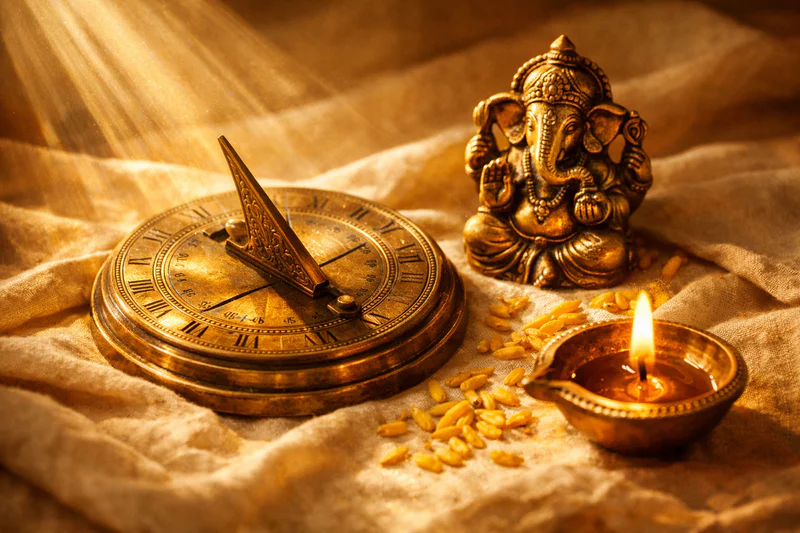
What Is a Muhurtham?
The word muhurtham (also written as muhurta) comes from Sanskrit and originally referred to a unit of time — roughly 48 minutes, one-fifteenth of the daylight period. Over time, the term expanded to describe specific time windows that are either auspicious (shubh) or inauspicious (ashubh) for beginning important actions.
The concept sits at the heart of the Hindu almanac, the Panchangam (పంచాంగం). The Panchangam tracks five key elements of time each day: the lunar day (Tithi), the weekday (Vara), the lunar mansion (Nakshatra), the planetary combination (Yoga), and the half lunar day (Karana). Muhurtham calculations draw on all of these elements, especially the Nakshatra and the local sunrise and sunset times.
The underlying belief is practical: time itself carries different qualities. A seed planted in fertile soil grows better. A meeting scheduled during a strong, harmonious time period is more likely to proceed smoothly. Muhurtham is the art and science of finding that fertile soil in the calendar of each day.
The 6 Key Daily Time Windows Explained
Six time windows appear in the Telugu Panchangam every single day. Three are auspicious windows to seek out; three are inauspicious periods to avoid. Here is what each one means and how it is calculated.
Abhijit Muhurtham (అభిజిత్ ముహూర్తం) — The Crown Jewel of Auspicious Time
Abhijit means "the victorious one" in Sanskrit. Among all daily muhurthams, this is considered the most powerful auspicious window — so potent, according to the texts, that it can override the negative influence of almost any other inauspicious factor present on that day.
Abhijit Muhurtham is the 8th of the 15 equal time segments that divide the period from sunrise to sunset. Because it falls exactly in the middle, it is centered on local solar noon — the moment the sun reaches its highest point in the sky. The window opens approximately 24 minutes before solar noon and closes approximately 24 minutes after, giving a total duration of about 48 minutes.
For a location where sunrise is at 6:00 AM and sunset at 6:00 PM, Abhijit Muhurtham falls from 11:36 AM to 12:24 PM. But because sunrise and sunset times shift throughout the year and differ by location, the exact window changes daily. A Panchangam app calculates this precisely for your city.
When to use it: Starting a new business venture, launching a product, filing important paperwork, seeking a job, or beginning any undertaking where success is paramount.
One important note: Abhijit Muhurtham is traditionally considered absent on Wednesdays, as that day is associated with the Abhijit Nakshatra in a way that diminishes the window's efficacy according to classical texts. Most Panchangams will reflect this.
Amrit Kalam (అమృత ఘడియలు) — The Nectar Window
Amrit means nectar — the drink of the gods, the elixir of life. Amrit Kalam (also called Amrit Ghadi) lives up to that name. It is regarded as the most auspicious window of the day for pooja, spiritual practice, and ceremonies of healing or blessing.
Unlike Rahukalam or Abhijit Muhurtham, which follow weekday-based patterns, Amrit Kalam is calculated directly from the Nakshatra — the lunar mansion occupied by the Moon on that day. Each of the 27 Nakshatras has a corresponding "nectar ghadi" — a specific set of time units (ghadis) within the day when cosmic energy is concentrated favorably. The calculation involves the Moon's position, the Nakshatra's transition time, and the local sunrise.
Because the Moon moves roughly one Nakshatra per day, Amrit Kalam shifts completely from one day to the next. Some days it falls in the early morning; others in the afternoon or evening. There can occasionally be two Amrit Kalam windows in a single day, or none at all. This is why a daily Panchangam — one calculated for your precise location — is essential rather than a static chart.
When to use it: Morning or evening pooja, spiritual rituals, taking new medicines, commencing fasting, and any activity associated with purification, health, or divine grace.
Rahukalam (రాహుకాలం) — The Shadow Hour to Avoid
Rahukalam is the most widely observed inauspicious period in South Indian Hindu tradition. It is named after Rahu, the north lunar node — a shadowy, headless celestial body in Vedic astrology associated with illusion, sudden upheaval, and unfinished business. Rahu's energy is considered disruptive to new beginnings.
Like all daily time windows, Rahukalam is calculated by dividing the daylight period (sunrise to sunset) into eight equal segments. Rahu governs one specific segment each weekday, following a fixed pattern. The mnemonic often taught is: "Mother Saw Father Wearing The Turban Suddenly" — the first letter of each word corresponds to the weekday order (Monday, Saturday, Friday, Wednesday, Thursday, Tuesday, Sunday), and each falls on the 2nd through 8th segment respectively.
The approximate Rahukalam timings — based on a 6:00 AM sunrise — are:
These are reference timings only. If your sunrise is at 6:30 AM, every window shifts by 30 minutes. If you are in a city with a sunrise at 5:45 AM, the shift is the opposite. A location-aware Panchangam app gives you the exact time for your city on any given day.
What to avoid during Rahukalam: Starting a new business, signing contracts, beginning travel, conducting ceremonies, making major purchases, or launching anything you want to succeed. Routine work already in progress is generally considered unaffected.
Yamagandam (యమగండం) — The Hour of Yama
Yama is the god of death and dharma in Hindu cosmology — a figure associated not with malice but with the enforcement of cosmic order and consequence. Yamagandam is his daily hour: a period considered deeply inauspicious for any auspicious activity or new beginning.
The calculation method mirrors that of Rahukalam — the daylight period is divided into eight segments and Yama claims one per weekday. The approximate timings (again, based on a 6:00 AM sunrise) are:
Notice that Yamagandam and Rahukalam never overlap on the same day — they occupy different segments. Together, they effectively mark off three or more hours of the day that traditional observance treats as unsuitable for auspicious beginnings.
When to be cautious: Travel, especially long journeys or journeys for important purposes, is particularly associated with caution during Yamagandam. Medical procedures, ceremonies, and financial commitments are also best rescheduled if possible.
Durmuhurtham (దుర్ముహూర్తం) — The Difficult Hour
The name says it plainly: dur means bad, and a Durmuhurtham is a bad time window. It is sometimes called the "evil hour," though a more accurate translation would simply be "inauspicious hour." Durmuhurtham typically occurs once or twice a day, each window lasting approximately 48 minutes.
What distinguishes Durmuhurtham from Rahukalam and Yamagandam is how it is calculated. Rather than following the simple sunrise-to-sunset division into eight segments, Durmuhurtham is determined by the weekday's ruling planet and the specific muhurta count within the day's 15 equal segments. This means its position in the day varies in a more complex pattern, and on Saturdays, it can extend somewhat longer than the standard 48-minute window.
A rough guide: Durmuhurtham generally falls in the morning on some days and in the afternoon on others, and in many cases twice — once before noon and once after. The precise timing is always date- and location-specific.
Activities to avoid: All shubha karyas (auspicious ceremonies and works) — wedding rituals, engagements, griha pravesham, naming ceremonies, starting new academic programs, or making offerings at a temple with specific intentions.
Varjyam (వర్జ్యం) — The Time to Be Avoided
Varjyam means "that which is to be abandoned" or "that which must be avoided." It is a Nakshatra-based inauspicious time window that typically lasts approximately 96 minutes (four ghadis) — making it longer than most other windows. Some days may carry two Varjyam windows.
The calculation is rooted entirely in the daily Nakshatra. Each of the 27 Nakshatras has a corresponding inauspicious time segment — a slice of the Nakshatra's duration when its energy turns unfavorable. This is sometimes called Nakshatra Thyajyam in Tamil tradition or Visha Ghatis (poison hours) in North Indian usage. Because the Moon moves continuously through the Nakshatras, Varjyam shifts completely from day to day, unlike the more predictable weekday-based patterns of Rahukalam and Yamagandam.
Activities to avoid during Varjyam: Marriages, house entries (griha pravesham), Chudakarana (first hair cutting ceremony), Annaprasana (the first feeding ceremony for infants), travel, and any other auspicious work. In essence, Varjyam applies the same level of caution as Rahukalam.
The fact that Varjyam cannot be predicted from a simple weekday table is precisely why a daily Panchangam is valuable — no static chart can tell you where Varjyam falls today.
Practical Guide: Which Muhurthams Matter for Which Occasions?
Not every occasion requires checking all six windows. Here is a practical guide to help you prioritize:
Starting a business or launching a new venture: Seek Abhijit Muhurtham or Amrit Kalam. Actively avoid Rahukalam, Yamagandam, and Varjyam. These are high-stakes irreversible decisions where timing genuinely matters according to tradition.
Griha Pravesham (housewarming) and buying property: All six windows become relevant. Durmuhurtham and Varjyam should be specifically avoided. A priest (purohit) will typically look for a day where Rahukalam, Yamagandam, Durmuhurtham, and Varjyam together create the smallest possible interference — and where Abhijit Muhurtham or a strong Amrit Kalam is available.
Travel: Check Yamagandam specifically — it carries the strongest traditional association with travel being complicated or dangerous. Rahukalam is also commonly noted before departures. For routine commuting, most people do not check every window; but for long journeys or travel with significant purpose (medical trips, immigration, business), the Panchangam is consulted seriously.
Pooja and spiritual practice: Amrit Kalam is the ideal window. Early morning after sunrise, before Rahukalam begins, is also generally favorable. Brahma Muhurtham — the period roughly 1.5 hours before sunrise — is traditionally ideal for meditation and prayer, though it is distinct from the six windows described here.
Shubh muhurat for pooja at home: Check that you are not within any of the three inauspicious windows (Rahukalam, Yamagandam, Varjyam) for that day. If Amrit Kalam is also present during your chosen window, that is an especially auspicious combination.
Signing contracts and financial decisions: Treat these like business beginnings — favor Abhijit Muhurtham and avoid Rahukalam and Yamagandam.
Why Your Location Changes Everything
One of the most important and often misunderstood aspects of the muhurtham system is that all timings are sunrise-relative. Every window — Rahukalam, Yamagandam, Abhijit Muhurtham, Durmuhurtham — is calculated from the precise moment of local sunrise at your geographic location. Varjyam and Amrit Kalam are further shaped by the Moon's Nakshatra position, which transitions at different local times depending on where you are.
This means a Telugu family in Hyderabad and a Telugu family in Singapore are observing different Rahukalam times on the same day — even though they follow the same tradition. The difference is not symbolic; it can be an hour or more.
Consider the contrast across cities where Telugu communities live:
Hyderabad has a sunrise around 6:15–6:45 AM depending on the season
Vijayawada, being nearby, is close but not identical
Singapore, at 1°N latitude, has a remarkably consistent sunrise around 6:55–7:10 AM all year, with minimal seasonal variation
New York has extreme seasonal variation — sunrise ranges from around 5:25 AM in June to 7:20 AM in January
London swings even more dramatically, from 4:45 AM in summer to 8:05 AM in winter
Sydney experiences the same seasonal swing but with the seasons reversed
A Rahukalam chart printed in a Telugu newspaper in India is simply wrong for a family in New York, London, or Sydney. A good digital Panchangam automatically detects your location or lets you select your city and recalculates every window from that day's actual sunrise and sunset times.
This is also why the reference timings shown in tables throughout this guide are marked "approximate" — they are correct only when sunrise falls at exactly 6:00 AM. They serve as a mental framework, not as daily guidance.
Common Misconceptions About Muhurthams
"Rahukalam is the same time every week." Only approximately, and only if you live at a location with a year-round 6:00 AM sunrise. In reality, Rahukalam on a Monday in December may start 45–60 minutes later than it does in June for the same city. The weekday pattern (Monday = 2nd segment, Saturday = 3rd segment, etc.) is fixed, but the clock times shift with every sunrise.
"If I miss the auspicious muhurtham, I should wait for another day." Not necessarily. Abhijit Muhurtham occurs every day except Wednesday. Amrit Kalam also recurs daily. There is usually a practical window available on any given day. The goal is awareness and timing, not paralysis.
"Inauspicious muhurthams mean something bad will happen." The traditional view is more nuanced. These periods are considered less favorable for initiating new actions — not inherently catastrophic. Ongoing work, routine tasks, cooking, exercise, and daily obligations proceed normally. The caution applies specifically to beginning important auspicious activities.
"A pandit must be consulted for every muhurtham." For major life events — weddings, griha pravesham, upanayanam — consulting a priest or Jyotish expert is traditional and often valuable because they look at multiple Panchangam elements together (Tithi, Nakshatra, Yoga, Karana, the lagna at the time, and more). For daily activities like checking an auspicious time for a pooja or a business meeting, a reliable Panchangam app is sufficient.
"All Panchangams show the same muhurtham times." There are different calculation traditions (Drik Ganita versus older ayanamsha-based systems), and some Panchangams use different reference points. For Telugu tradition, the Drik Panchangam system is the modern standard, calculating positions from the actual astronomical positions of celestial bodies. Always verify your Panchangam is location-specific.
Frequently Asked Questions
What is the most auspicious time today?
The most powerful auspicious window on any given day is Abhijit Muhurtham — approximately 24 minutes before to 24 minutes after local solar noon. On most days, a good Amrit Kalam window also exists, calculated from the day's Nakshatra. To find today's exact timings for your city, use a location-aware Panchangam like the Telugu Calendar app.
What is Rahukalam and why should I avoid it?
Rahukalam is a 90-minute window every day governed by Rahu, the north lunar node. Traditional Vedic astrology considers Rahu's influence disruptive to new beginnings. Avoiding Rahukalam for starting important activities — signing agreements, launching ventures, beginning ceremonies — is standard practice across South India. Routine ongoing work is not affected.
Is Rahukalam the same as Durmuhurtham?
No. They are distinct windows calculated by different methods. Rahukalam is calculated from the weekday's position within the eight segments of the day. Durmuhurtham is calculated from the day's 15 muhurta divisions and the weekday's ruling planet. On any given day, they fall at different times and should be checked separately.
How is Varjyam different from Rahukalam?
Varjyam is Nakshatra-based — it shifts completely from day to day depending on the Moon's position and cannot be predicted from a weekday table. Rahukalam follows a consistent weekly pattern (adjusted for local sunrise). Both are inauspicious for auspicious beginnings, but Varjyam is generally associated more specifically with marriage rituals, house entries, and ceremonies involving new journeys of life.
Does muhurtham time differ for Telugu families living outside India?
Yes — significantly. All muhurtham timings are calculated relative to local sunrise and sunset. A Telugu family in Singapore observes different Rahukalam and Abhijit Muhurtham times than one in Hyderabad, even on the same calendar day. Using a Panchangam app that auto-detects or allows you to select your city (Hyderabad, Vijayawada, Singapore, New York, London, Sydney, or anywhere else) ensures you get accurate local timings rather than India-centric approximations.
Know Your Muhurtham Today — Wherever You Are
The muhurtham system carries thousands of years of accumulated observation about time and human action. Whether you are in Hyderabad preparing for a griha pravesham, in Singapore looking for an auspicious time for a morning pooja, or in New York planning a business call on a Tuesday, the same six windows govern your day — just at different clock times.
The Telugu Calendar app makes this effortless. It calculates your daily Muhurtham today — Rahukalam, Yamagandam, Durmuhurtham, Abhijit Muhurtham, Amrit Kalam, and Varjyam — with precision, based on your actual location and the current date. The app supports Telugu families in Hyderabad, Vijayawada, Singapore, New York, London, Sydney, and beyond, delivering an accurate daily Panchangam in your pocket.
Download the Telugu Calendar app on the App Store and start every day knowing exactly when to act — and when to wait.